
Why Emergency Repairs Without Documentation Fail
- Oseye Cohen, A.I.M.A

- Jan 26
- 3 min read
ADVANCED WINTER RISK SERIES

Do you need documentation for insurance claims?
Yes. Insurance claims require proof of damage, timing, and mitigation steps. Without documentation, claims may be delayed, reduced, or denied
The Common Mistake in Emergency Situations
When damage occurs, the instinct is immediate:
Fix it. Stop the problem. Move on.
And that’s exactly where things go wrong.
Because in property damage situations—especially those involving insurance—
The repair is only half the job. The documentation is what protects the claim.
What Happens When There’s No Documentation
Emergency repairs without proper records create gaps:
No clear record of the original damage
No timeline of when the issue occurred
No proof of mitigation steps taken
No evidence supporting the scope of work
From an insurance perspective, that creates uncertainty.
And uncertainty leads to:
Delayed claims
Reduced payouts
Disputed scope of damage
In some cases, it leads to denial.
The Insurance Reality
Insurance claims are not based on assumptions.
They are based on:
Evidence
Timing
Conditions being met
If damage is repaired before it is:
Documented
Reported
Reviewed
Then key information is lost.
Once the damage is gone, so is the proof.
What Proper Documentation Looks Like
Effective documentation includes:
Before Repairs
Photos and videos of the damage
Clear identification of affected areas
Notes on conditions (moisture, temperature, visible spread)
During Mitigation
Steps taken to stop further damage
Materials removed or affected
Timeline of actions
After Repairs
Completed work photos
Summary of what was addressed
Confirmation of restored condition
This creates a complete record of the event.
Where Emergency Situations Go Wrong
In real scenarios, we often see:
Contractors called immediately with no documentation taken
Water extracted and materials removed before photos
No written record of initial conditions
Delayed communication with insurers
By the time a claim is submitted:
The damage has already been altered
Key evidence is missing
And now the burden shifts to the property owner.
Why This Matters More in Vacant Properties
Vacant properties already carry higher risk:
Delayed detection
No daily monitoring
Increased exposure to weather-related damage
When an emergency occurs:
There is no occupant to report details
No immediate timeline
No firsthand account
Which makes documentation even more critical.
The Real Cost of Skipping Documentation
Without proper documentation, property owners may face:
Reduced claim values
Disputes over cause of damage
Delays in claim processing
Out-of-pocket repair costs
All from a situation that was handled—but not recorded.
What Property Owners Should Do
In any emergency situation:
✔️ Document first (if safe to do so)
Capture the condition before changes are made.
✔️ Notify your insurer promptly
Timing matters.
✔️ Keep a clear record
Photos, notes, timestamps.
✔️ Ensure contractors document their work
Not all do—this is often overlooked.
Where 12 Gates Property Services Fits In
At 12 Gates Property Services, we focus on:
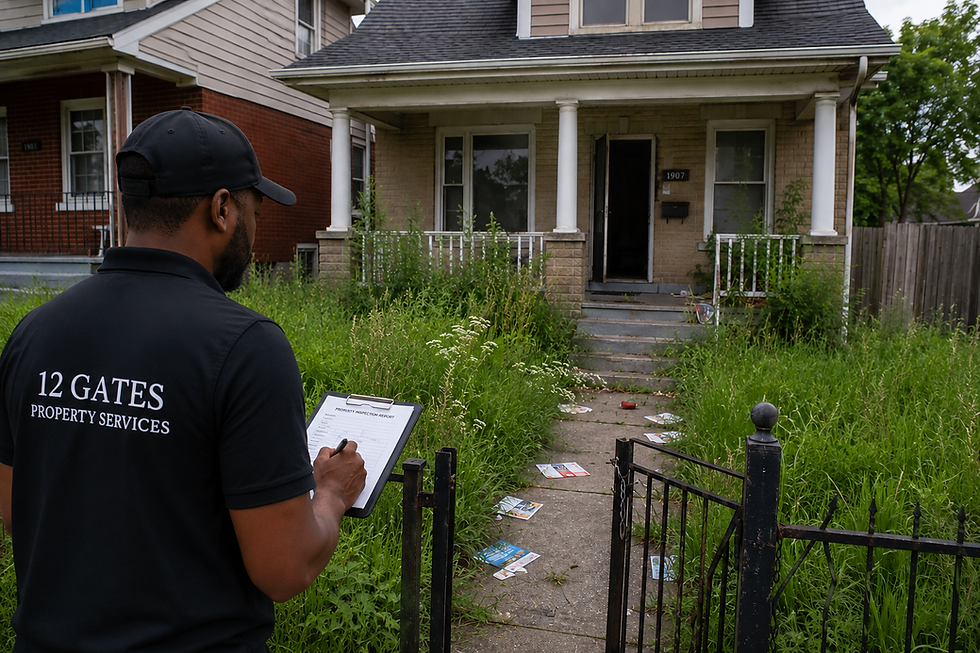
Structured oversight and documentation during critical moments.
We:
Capture pre- and post-condition reports
Document damage progression and mitigation
Coordinate with contractors and insurers
Ensure a clear record is maintained
Because in property damage situations, documentation is not an extra step—it’s protection.
Final Thought
Emergency repairs solve the immediate problem.
Documentation protects the outcome.
Without it, even a properly handled situation can become a complicated claim.
Take ACTION
If your property is:
Vacant
Between tenants
Sitting longer than expected
You shouldn’t be guessing about risk.
Visit 12GatesPS.com and book your free 15-minute consultation.
We’ll help you:
Identify water-related risks
Prioritize what actually needs attention
Put a simple, structured plan in place
12 GATES PROPERTY SERVICES - PROTECTING POPERTIES. MINIMIZING LOSS.


Comments